 +35797909751


Why Couples Choose a Villa Over a Hotel or Resort
A premium hotel can produce a beautiful wedding. The reasons couples still choose a villa fall into four categories, and they're usually decided before the first site visit.
Privacy. A villa is yours from the moment of arrival to the morning departure. No other weddings in the next ballroom, no hotel guests passing through the ceremony space, no shared lobby on the morning of the wedding. For couples who want the day held entirely within their own circle, this is the single defining advantage.
Continuity. A villa wedding doesn’t end at the reception. Welcome dinners on Thursday, the ceremony and main celebration on Saturday, a brunch overlooking the sea on Sunday — all in the same setting, with the same staff who already know your guests by name. The day expands into a weekend, and the weekend produces a different kind of memory than a single evening.
Creative latitude. Hotels and resorts run on their own kitchens, their own preferred suppliers, and their own setup windows. A villa lets you bring in the chef you want, the florist whose work you’ve followed for years, the lighting designer you trust, and the production team that builds the day around the brief — not around the venue’s standard package. For a comparison of how each venue category handles this, see our guide to wedding venues in Cyprus.
The view. Cyprus villa estates sit in places hotels cannot. Cliffs above the Akamas. Hills behind Limassol with the city below at sunset. Stone properties in the Troodos foothills with vineyards stepping down to the south. These settings are not in any resort’s brochure because they belong to private estates that open for a small number of weddings each year.

A villa is not a wedding venue with rooms attached. It is a private estate that becomes the wedding for three days. Plan it that way from the start.
How Much Does a Wedding at a Luxury Villa in Cyprus Actually Cost?
Premium villa rentals on the island typically run €8,000–€25,000+ for a long wedding weekend, before any production. Total budgets at this level start around €60,000 and run past €200,000 for full multi-day productions with bespoke design, premium catering, and a guest list of 60–100 people. The variables are the same as any wedding — guest count, season, vendor selection — but at this scale, the differences compound. For how these proportions compare against mid-range weddings on the island, see our Cyprus wedding cost guide.
The shape of a typical luxury villa wedding budget looks like this:
| Category | Share of total |
|---|---|
| Villa rental and accommodation | 15–25% |
| Catering, bar, and chef | 25–35% |
| Design, florals, and lighting | 15–25% |
| Production and planning fees | 10–15% |
| Photography, video, and content | 8–12% |
| Entertainment (live music, DJ, performers) | 5–10% |
| Guest experience (transport, welcome bags, concierge) | 5–8% |
Four Categories of Villas on the Island
Cyprus has four types of villa estates that work for luxury weddings, and choosing between them is the most consequential early decision. A villa is not a wedding venue with rooms attached — it is a private estate that becomes the wedding for three days, and it should be planned that way from the start.
Seafront and clifftop villas
The most photographed category. Villas perched on private coastline offer ceremony spaces with the Mediterranean as the entire horizon. The areas worth shortlisting are Sea Caves and Agios Georgios (St George) in Peyia, on the Paphos coast toward the Akamas — the island’s densest concentration of clifftop luxury villas — along with Latchi and Neo Chorio near the Akamas peninsula, Pissouri Bay between Limassol and Paphos, and the eastern coastline around Protaras and Cape Greco. The trade-offs are wind (real, plan for it) and accessibility (some are deliberately remote). Best for weddings that want the sea as the centrepiece rather than the backdrop.
Hillside estates above Limassol and Paphos
The most production-friendly category. Hillside estates typically come with established infrastructure — full power for outdoor production, prepared ceremony lawns, established gardens, on-site staff quarters. The strongest areas are the Limassol foothills around Palodia, Kalogiroi, and Parekklisia, and above Paphos the villages of Tala, Konia, Tsada, and the Aphrodite Hills estate at Kouklia. The view is the city, the coast, and the sunset rather than direct sea access. Best for larger guest counts (60–100) and full multi-day programmes.
Restored stone properties and vineyard estates
The most distinctive category. Restored stone villas and vineyard estates produce celebrations that don’t look like anyone else’s. Look at Kalavasos and Tochni in the Larnaca district — both known for restored stone properties and agrotourism estates — along with Omodos, Vouni, and Lofou in the Limassol wine villages, and Lefkara for its stone architecture and craft heritage. The constraint is scale: these properties suit 30–60 guests well, and larger groups stretch them. Best for couples who want the wedding to feel rooted in Cyprus rather than in a Mediterranean coastal cliché.
Private modern villas
The fastest-growing category over the past five years. Architect-designed contemporary villas with infinity pools, open-plan living, and minimalist landscaping — concentrated in the hills above Paphos (Tala, Peyia, Chloraka) and along the eastern Limassol coast toward Pyrgos and Governor’s Beach. Best for couples whose aesthetic is contemporary rather than classical and who want a setting that reads as their own home for the weekend.
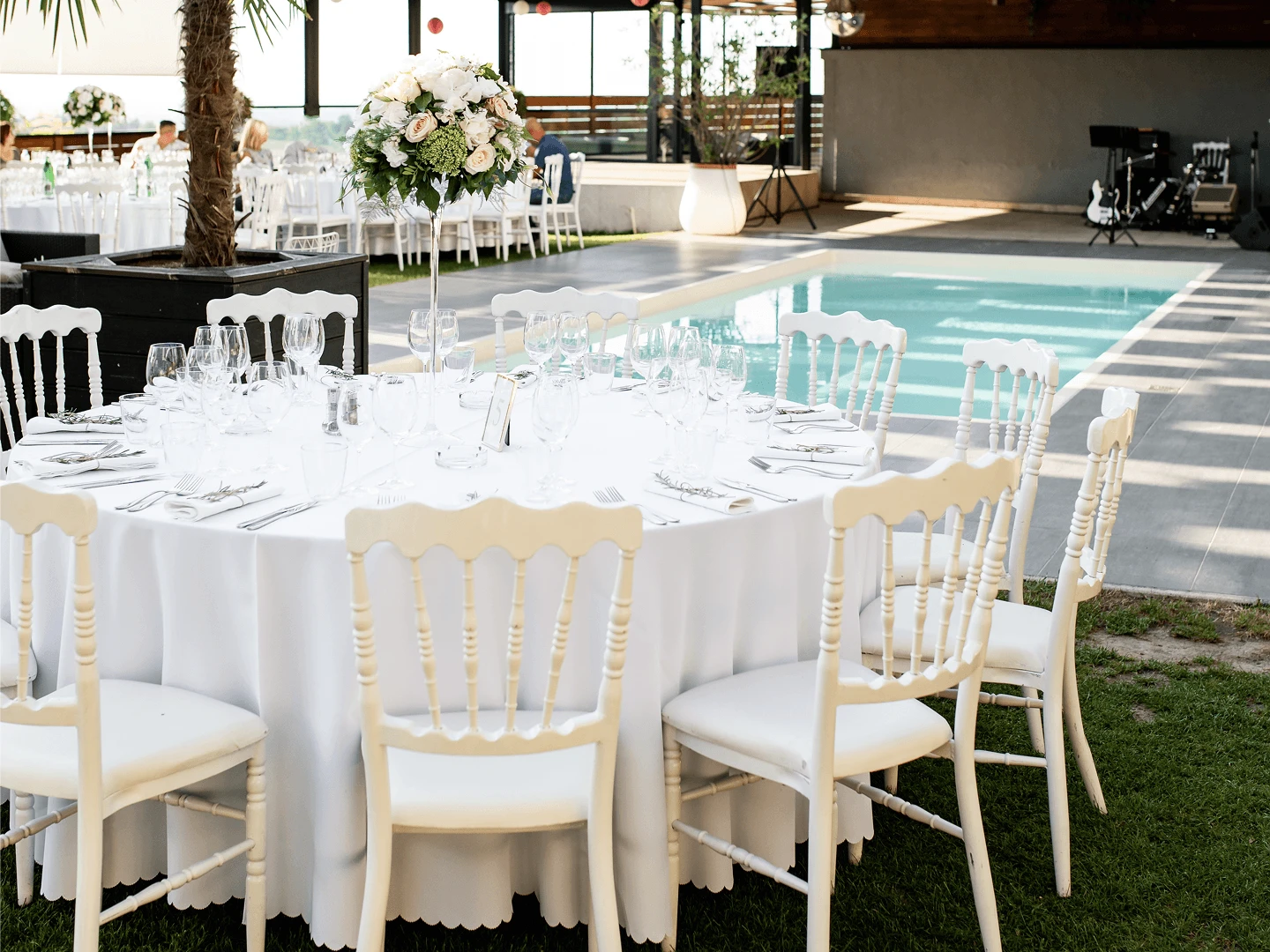
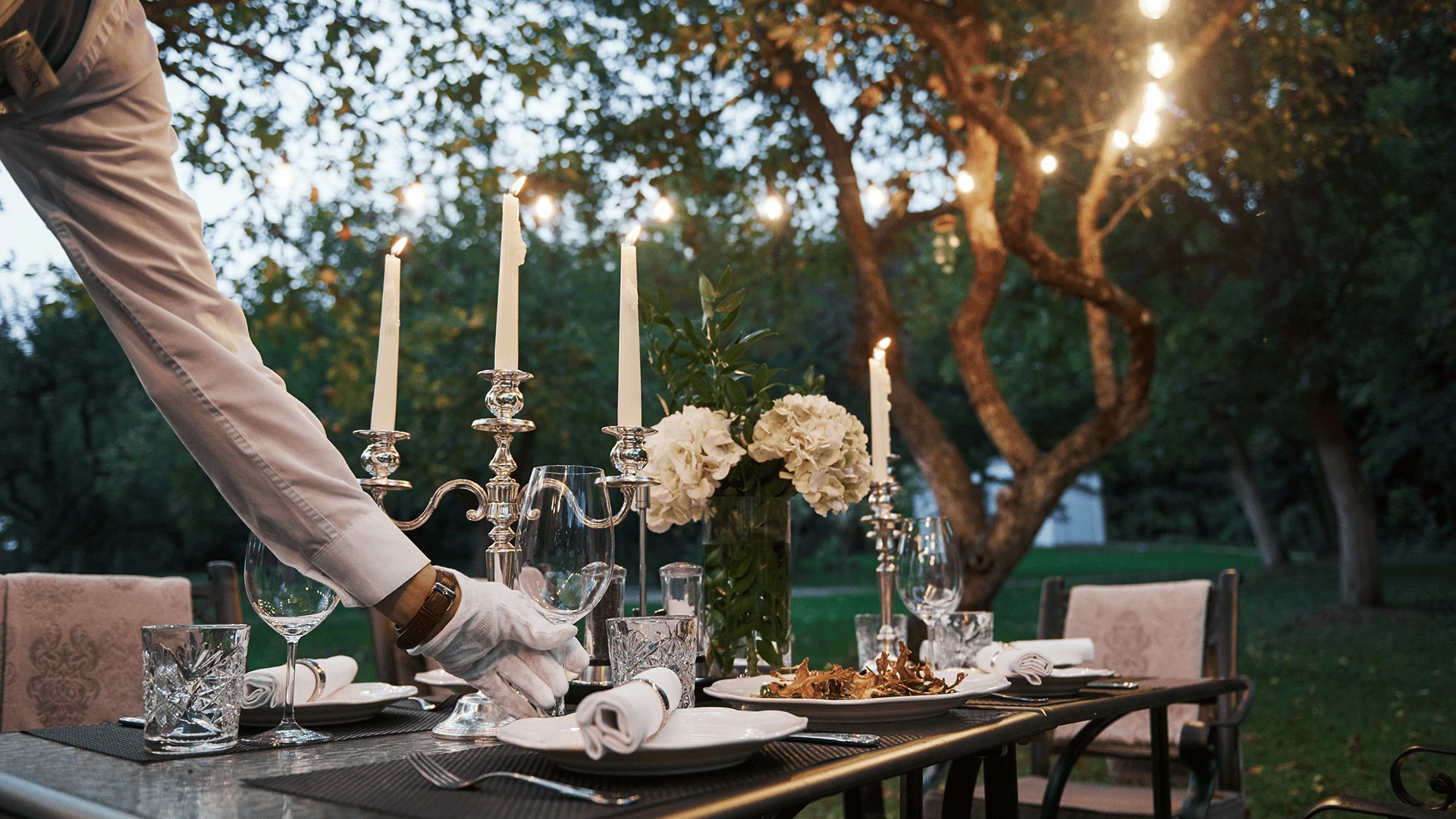
Private villa welcome dinner on a pool terrace in the Paphos hills, with long candlelit table and intimate guest seating.
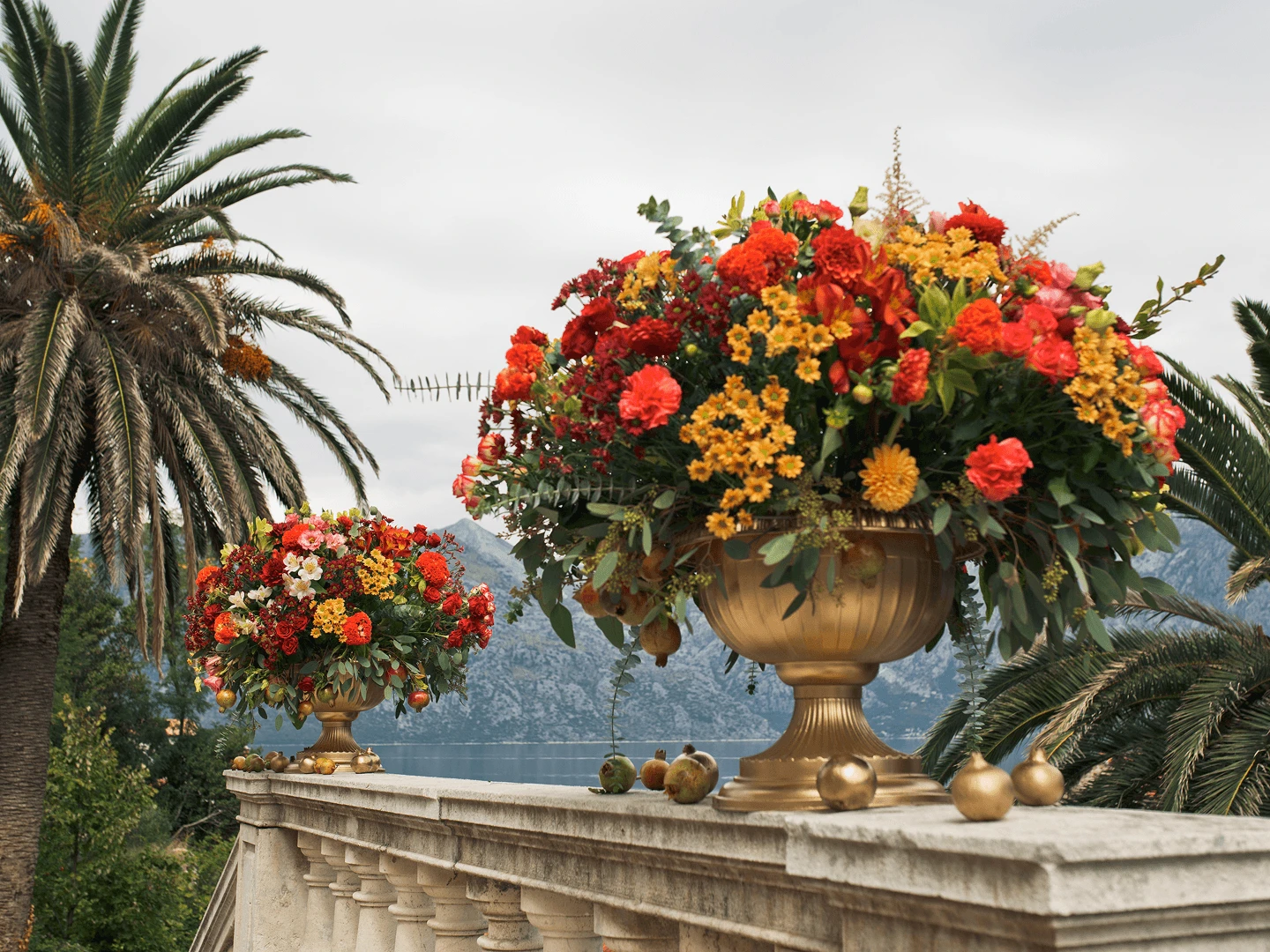
Custom floral installation in the courtyard of a stone villa estate near Omodos, designed for a luxury wedding ceremony.
Villa Selection Checklist: Five Questions to Ask Before Booking
Most villa contracts are signed after a site visit that focused on the view. These five questions determine whether the property can actually host a wedding — ask them in writing before any deposit.
- Does the villa permit outdoor music after 11 pm, or is there a strict noise curfew? Residential-adjacent estates often have earlier cut-offs than couples expect, and this single answer reshapes the entire evening timeline.
- Is there a dedicated 32A or 63A electrical distribution box for event lighting and AV? Without one, you are budgeting for generators — and the silent models cost considerably more than the loud ones.
- Does the rental fee include setup and breakdown days, or are those billed separately? A three-day wedding weekend often needs five days of access; the difference frequently runs €500–€2,000.
- Are there mandatory vendor lists, or can we bring our own private chef and caterer? Creative latitude is the main reason to choose a villa, and a restricted supplier list removes much of it.
- What is the indoor air-conditioned backup capacity if evening winds spike or the weather turns? A villa designed for fifteen residents rarely accommodates eighty guests indoors without a plan.
A villa that answers all five clearly and in writing has hosted weddings before. One that answers vaguely has not.
The Multi-Day Rhythm that Defines a Luxury Villa Wedding
A luxury villa wedding works because it stops being a single event. The most considered weddings at this level follow a three- or four-day arc that uses the villa for what it actually is — a private home for a small group of people over a long weekend.
- Thursday: arrival and welcome. A relaxed dinner on-site for the immediate wedding party and family. Often a barbecue, often by the pool, almost always casual. The point is to take the formality out of the first meeting between two families and let the staff start learning names.
- Friday: rehearsal and welcome event. A morning rehearsal of the ceremony. An afternoon free for guests to settle into accommodation or explore. A welcome cocktail or dinner that evening — sometimes at the villa, sometimes at a nearby restaurant booked out privately. This is the night that sets the tone for the wedding day. The welcome evening and the reception are where the entertainment programme does its work — our wedding entertainment ideas for Cyprus cover the live music, show acts, and performers that carry a multi-day villa celebration.
- Saturday: the wedding. Ceremony, cocktail hour, dinner, dancing. The day everyone flew in for.
- Sunday: farewell brunch. A late, slow brunch at the villa. Often, the most loved meal of the weekend because everyone is unguarded by then, and the wedding has already happened. Guests leave through the afternoon.
This rhythm is what couples mean when they say a villa wedding is “worth it.” It produces a different kind of memory than a one-evening hotel celebration — closer, slower, more personal.
Production Realities: What Couples Consistently Underestimate
A luxury villa wedding is a small construction project. Five things consistently surprise couples planning their first one.
- Catering infrastructure. Most villas do not have a commercial kitchen. Catering for 60+ guests means a mobile kitchen on-site, refrigeration units, dishwashing capacity, and staff overnight accommodation. Premium catering teams handle this — but it has to be budgeted from the start, not added later.
- Power. Outdoor lighting design, DJ rigs, AV, stage lighting, mobile kitchens, and climate control draw far more power than a residential villa supplies. A generator — sometimes two — is standard at premium villa weddings, and the silent ones cost meaningfully more than the loud ones.
- Climate control. A villa is designed for fifteen people across air-conditioned rooms. A wedding puts 80 people in adjacent outdoor spaces. Cooling stations, fans, shaded zones, and indoor cooling backup all need designing.
- Sanitation. Premium portable bathrooms — the kind that don’t read as portable — are €1,500–€4,000 for the weekend and are not optional for outdoor weddings of more than 40 guests.
- Permits and noise. Villa weddings in residential-adjacent areas come with amplified music cut-offs that can be as early as 11 pm. Verify before signing — the venue knows, but doesn’t always volunteer the information.
These aren’t reasons not to do a villa wedding. They’re reasons to work with a planner who knows them before the contract is signed.
What Separates a Good Luxury Wedding From a Forgettable One
At premium budgets, the difference between a beautiful wedding and an extraordinary one is rarely the budget itself. It’s the editing.
- Restraint in the design. The most considered luxury weddings on the island lean cleaner, not louder. One signature floral installation rather than seven. A single colour palette held across every element. Lighting that disappears into the architecture instead of competing with it.
- Investment in the guest experience. A premium villa wedding lives or dies on how the guests feel across the weekend — the welcome bag in the room on arrival, the transport that runs on time, the chef who comes out to greet the table, the concierge who handles the small problems before the couple ever hears about them.
- A creative direction with a point of view. Generic luxury — chiavari chairs, white floral arches, gold flatware — looks the same everywhere. The weddings that produce work worth publishing are the ones where the couple’s actual taste shapes every decision, and the planner protects that taste from the easy defaults.
- Time spent on the small things. The menu cards. The seating arrangement. The ceremony music. The first dance that actually suits the couple, rather than the playlist algorithm. At premium budgets, the things guests remember are the personal ones — and those take time, not money.
Villa vs Yacht: The Comparison Couples Ask About
Yacht weddings come up at this budget level for the same reasons villa weddings do — privacy, distinctiveness, the chance to do something different. Both work. The honest comparison is this.
| Category | Villa | Yacht |
|---|---|---|
| Guest range | 30–120 | 20–60 |
| Programme | Multi-day weekend | Single day or evening |
| Creative production | Full — everything is built | Constrained by deck space |
| Logistics | Simpler, fixed location | More complex, precise timing |
| Weather backup | Covered zones on site | Mandatory, and harder to arrange |

Ready to Plan Your Wedding in Cyprus?
We handle everything — venue, décor, catering, entertainment & logistics. Zero stress, zero waste.

Common Questions about Luxury Villa Weddings in Cyprus
How to plan a luxury wedding at a villa in Cyprus?
Start with the villa, the date, and the guest count — in that order. Once those three are locked, build outward: legal paperwork, full production team, design direction, vendor selection. The most successful luxury villa weddings have a planner engaged twelve to eighteen months before the date, who manages every element from the villa contract onward. The date deserves particular care at this level, since the villas worth having book out first — our guide to the best time for a wedding in Cyprus breaks down which months suit a multi-day villa programme.
Which areas of Cyprus have the best luxury wedding villas?
For clifftop and seafront estates, Sea Caves and Agios Georgios in Peyia lead, along with Latchi near the Akamas and Pissouri Bay. For production-friendly hillside estates, the Limassol foothills around Palodia and Parekklisia, and Tala, Konia, and Aphrodite Hills above Paphos. For restored stone properties, Kalavasos and Tochni in the Larnaca district, and the Limassol wine villages around Omodos and Lofou.
Is a villa or a yacht better for a luxury wedding?
A villa suits longer programmes, larger guest counts, and full creative production. A yacht suits smaller, sea-led celebrations with shorter run times. Both are excellent — the right answer depends on how many guests will fly, how many days you want to host them, and whether you want the venue to be a place or a movement.
What is included in a high-end wedding experience?
At the premium level, a luxury wedding includes exclusive use of the venue across the wedding weekend, a private chef and bar team, custom-designed florals and lighting, premium photography and often cinematic video, a guest concierge service, ground transport for guests across the weekend, and end-to-end planning that handles every element from documents to departure. The defining feature is not what’s added — it’s that the couple is asked to make creative decisions, not logistical ones.
How far in advance should we book a luxury villa wedding?
Twelve to eighteen months for premium villa weddings during the peak May–October window. For shoulder-season and off-season dates, nine months can work. The villas that book out earliest are the ones with under-100 wedding capacity per year — and they’re often the most distinctive.
Can we have a religious or civil ceremony at the villa?
Civil ceremonies can be held at the villa if the property is registered for that purpose, or by having the Marriage Officer travel to the location. Religious ceremonies (Orthodox, Catholic, Anglican) follow each faith’s own protocols and usually take place at a chapel or church, with the celebration moving to the villa afterward. Both formats are common; the paperwork timeline is the same either way.
Where to go from here
A luxury villa wedding in Cyprus is one of the few formats on the island that genuinely earns the word luxury — not because of price, but because of what it makes possible. A weekend with the people who matter most, in a place that becomes yours for three days, with every detail handled by a team that lets you stay focused on the wedding rather than the running of it.
If you’re planning at this level and want a planning team that understands the production side as well as the creative one, explore our luxury wedding service. The first conversation is about your villa, your guest list, and the weekend you want to host — the rest follows from there.
Last reviewed: July 2026. Villa rental pricing, premium vendor rates, and seasonal availability shift year to year — contact us directly for current villa availability and bespoke production estimates.