 +35797909751

Format first, figure second
The main reason companies struggle to estimate a budget early is asking "how much does a corporate event cost" without defining the format. It's like asking how much a car costs. The cost of a corporate event in Cyprus depends first and foremost on what you're actually planning.
The core formats and their order of cost per person:
- Business dinner or intimate reception — from €60–100 per person
- Team building (day programme) — from €50–120 per person, depending on activities
- Conference or forum — from €80–150 per person (venue, AV, coffee breaks, lunch)
- Corporate banquet with a programme — from €100–180 per person
- Gala format with show and styling — from €150–250 per person and up
- Event on a yacht — quoted individually, typically from €150 per person on larger vessels
These figures are starting reference points for the mid-market, not fixed rates. A premium venue, well-known performers, complex styling, or an authored production move them up significantly. And on Cyprus, figures are usually quoted excluding 19% VAT — the first thing to keep in mind when reading any proposal.

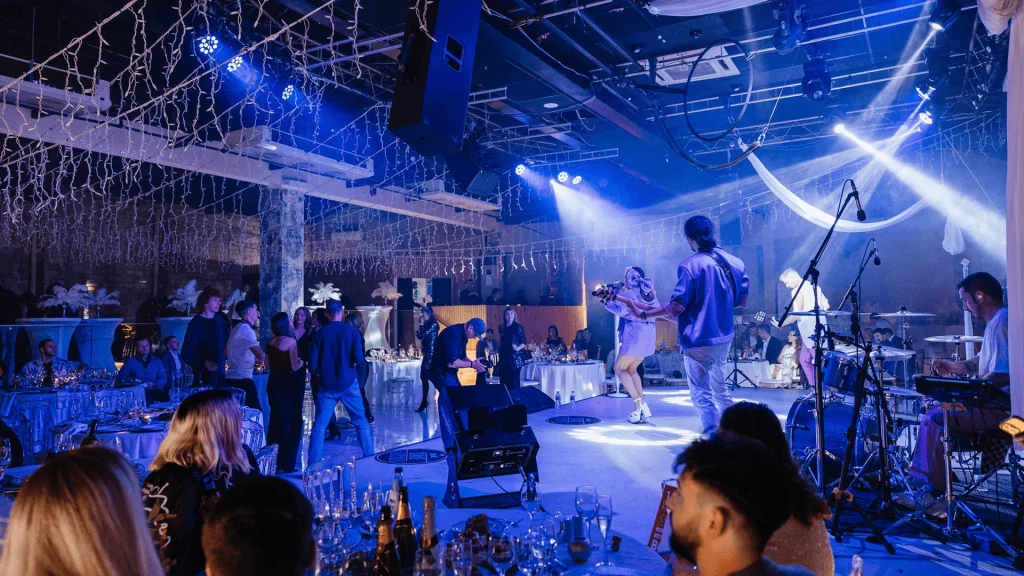
Venue and catering are almost always the largest line. Beyond that, much depends on format: a conference shifts weight toward technical production and AV; a gala toward programme and styling; a team building day toward activities and logistics.

Conference hall with AV equipment and staging in Cyprus — technical production as a key budget line.
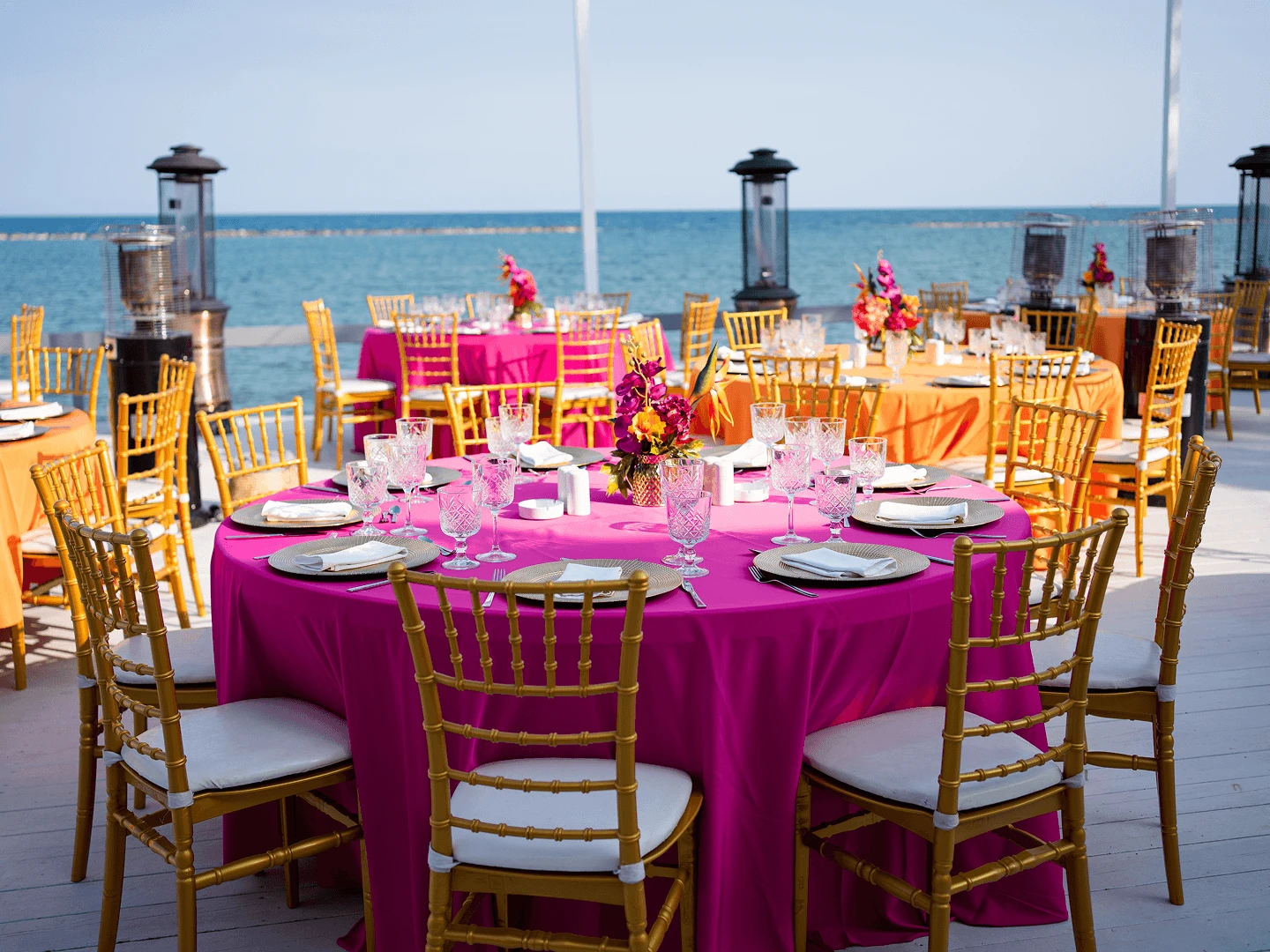
A corporate day on the water doesn't have to mean a tight schedule.
Where the budget goes
Most corporate events follow a predictable budget structure. For a mid-range format with a business and an entertainment component, the proportions typically look like this:
| Line item | Share of budget | What it covers |
|---|---|---|
| Venue and catering | 45–55% | Venue hire, food, drinks, service |
| Entertainment | 15–25% | Host, performers, show, DJ, interactive elements |
| Technical production | 10–20% | AV, sound, lighting, stage, screens, technical crew |
| Styling and branding | 5–15% | Décor, photo zone, corporate identity, print |
| Logistics | 5–10% | Transfer, coordination, participant accommodation |
| Contingency | 5–10% | Unforeseen costs |
Venue and catering
The largest block. Venue cost in Cyprus is structured differently depending on the type:
- Hotel conference halls are usually priced as a package: venue hire + AV + coffee breaks + lunch per participant. Convenient to calculate, less flexible.
- Restaurants often work not through venue hire but through a minimum food-and-beverage spend — you effectively “buy out” the space with a set order value.
- Private villas and unconventional venues are let for a fixed hire, to which all brought-in infrastructure is added.
Mid-range catering in Cyprus runs roughly €60–90 per person plus VAT for a full dinner with drinks. Premium cuisine raises that to €100–180 and up. Alcohol is priced separately: an open bar adds €20–40 per guest, depending on the package. For business formats, coffee breaks matter — their quality and number noticeably affect both the experience and the final figure.
Entertainment
The second-heaviest block for most formats. This covers the host, music (DJ or live), show acts, and interactive elements. A professional host runs from several hundred euros for an evening; a DJ from roughly €600–1,800 per event; live music and show acts are costed separately. Cutting the entertainment budget is the most visible saving to guests — an event that lacks momentum leaves a lasting negative impression, far more so than a modest menu.
Technical production
This is the block that companies most often underestimate. It covers AV equipment, sound, lighting, and the technical crew on site. For conferences and presentations, this is a critical line — you can’t economise here, because a technical failure during a keynote can undermine the entire event. In hotel conference halls, production is often partly included in the package; at unconventional venues and villas, all equipment is brought in, making it a substantial separate line.
Styling and branding
Décor in the event’s theme, photo zone, corporate identity, print materials. The weight of this line depends heavily on format: a business conference needs restrained branding, while a gala or themed event needs full styling of the space.
Logistics
Participant transfer, coordination, and, where needed, accommodation for out-of-town and international guests. For events outside the city — villas, resorts, yachts — logistics becomes a heavier line.
The cost drivers that move the budget the most
Three factors influence the final figure more than anything else — and they're the ones to manage first.
- Headcount. The most direct multiplier. Every additional guest means catering, drinks, a seat, sometimes a transfer, and a gift. Trimming the list by 20 noticeably lowers the budget without touching the quality of the event itself. Conversely, inflating the list “just in case” raises everything proportionally.
- Format and venue level. A business dinner in a restaurant and a gala at a premium villa are different orders of cost for the same number of guests. The venue type sets the floor for the entire budget.
- Seasonality and timing. In peak periods — the pre-Christmas season, the high tourist season — vendor rates are higher, and choice is narrower. Early planning delivers both better prices and wider availability. Late booking almost always means paying a premium for urgency and working with whatever remains.
How to allocate the budget without sacrificing quality
Sound budget allocation isn’t about cutting everything — it’s about choosing priorities deliberately. A few principles that work in practice.
- Invest in what everyone notices; economise on what few do. Guests remember the atmosphere, the momentum of the evening, the quality of the food, and the impression of the programme. They barely notice which exact equipment the sound ran on or what stock the print was on. Allocate toward the visible.
- Don’t economise on the host or on technical production for the business part. These are the two lines where a failure erases everything else. A weak host kills the momentum of the evening; a technical failure during a key address ruins the impression of an event that costs tens of thousands of euros.
- Manage the guest list deliberately. The cleanest way to reduce a budget without losing quality is an accurate list rather than an inflated one. That’s not cutting — it’s precision.
- Choose the format to match the objective, not the trend. An expensive gala isn’t needed if the goal is team cohesion, which a team building day at half the cost serves better. Matching the format to the objective saves more than any negotiation with vendors.
- Plan early. Early booking is the most underrated saving tool. The best venues and vendors at the best prices go first, especially in peak seasons.
- Build in a contingency. Projects without a 5–10% contingency line almost always face budget overruns. The contingency isn’t overspending — it’s protection against it.
- Work through a single producer. Assembling an event from many separate vendors directly often costs more, and carries more risk, than working through a single organiser who negotiates with suppliers at scale and takes responsibility for the result. Fragmented contracts mean not just a premium but the risk of mismatches on the day.


Hidden costs companies often miss
A few items regularly appear in the final quotation but not in the initial estimate:
- 19% VAT — on most services. Not an “extra” line but a baseline: a quote should always be read with tax in mind.
- Technical crew and overtime — AV specialists’ work, additional hours when an event runs long.
- Setup and breakdown — particularly at villas and unconventional venues, where these are separate days and separate charges.
- Transfer and accommodation — for out-of-town participants and out-of-city venues.
- Corporate gifts and prizes — where the programme includes them.
- Insurance and permits — for certain formats and venues.
A transparent quotation accounts for all of this from the outset. That’s precisely why a detailed estimate from an organiser is more valuable than a price range — it shows the full picture rather than just the top of it.

Are you planning a corporate event?
We organise corporate parties and summer events

Common questions about corporate event costs in Cyprus
How much does a corporate event cost in Cyprus?
It depends on the format and scale. An intimate business dinner runs from €60–100 per person. A conference, from €80–150 per participant with venue, AV, and catering. A corporate banquet with a programme, from €100–180. A gala format with show and styling, from €150–250 per person and up. All figures are quoted excluding 19% VAT and represent mid-market reference points — a premium venue, well-known performers, and a complex production move them higher.
Which factors affect the budget most?
Three drivers dominate: headcount (the most direct multiplier — every guest adds catering, drinks, and a seat), format and venue level (a restaurant dinner versus a premium villa gala are different orders of cost), and seasonality (peak periods like the pre-Christmas season carry higher rates and narrower choice). Manage these three first, and the budget becomes a controllable instrument rather than a source of uncertainty.
What can be optimised without hurting quality?
Invest in what everyone notices — atmosphere, momentum, food, programme — and economise on what few do. Never cut the host or the technical production for the business part, as a failure there erases everything else. Manage the guest list precisely rather than inflating it, match the format to the objective, plan early for better rates, and build in a 5–10% contingency. These deliver real savings without visible compromise.
Is VAT included in the quoted price?
Often not — especially in initial proposals. VAT in Cyprus is 19% and applies to most services, which means the real amount payable is noticeably higher than the headline “net” figure. Always confirm whether a quote is stated with or without VAT — on a large budget, the difference is substantial.
Is it cheaper to organise an event without an agency?
Not necessarily. Working directly with many vendors looks like a saving but often costs more in practice: the company pays retail rates, spends internal resources on coordination, and carries the risk of mismatches. A producer negotiates with suppliers at scale, takes responsibility for the result, and removes the operational load from the company. For one-off events, the organiser’s fee is typically recovered through better terms and prevented mistakes.
How far ahead should we plan the budget?
The earlier, the more accurate and cost-effective. For large formats and peak seasons — several months ahead. An early start delivers better venue and vendor prices, a wider choice, and time to optimise the estimate. Late planning almost always means paying a premium for urgency.
What to do next
A corporate event budget in Cyprus is, above all, a question of matching the format to the objective — and only then a matter of negotiating price. Once format, scale, and priorities are clear, the budget becomes a controllable instrument rather than a source of uncertainty. The key is deliberate allocation: investing in what creates the impression, and never economising on what could undermine it.
If you’re planning a corporate event and want a transparent estimate for your specific format, request a custom quotation. We’ll start with your objectives, format, and scale, then prepare a detailed quotation that shows the full picture of the spend, with no hidden lines surfacing on the day of the event.
Last reviewed: June 2026. The figures given are mid-market ranges that vary with format, season, vendor selection, and scale. The 19% VAT rate is accurate at the time of writing. A detailed estimate for a specific event is best calculated individually.
.