 +35797909751

Why does timing decide so much
How early you start shapes three things directly: choice, price, and peace of mind. The earlier you begin, the wider the choice of free dates, venues, and performers, the better the terms, and the fewer decisions you make under pressure.
The New Year season is a competition for the same resources. Venues, restaurants, villas, hosts, show teams, and caterers book out weeks ahead, and the most sought-after go first. A late start almost always means compromise — the wrong date, the wrong venue, a weaker programme, or paying more for whatever is left. Early planning removes that risk and leaves room for the idea, not for reactive problem-solving.

The easiest way to plan is backwards from the date.
The month-by-month calendar
The easiest way to plan is backwards from the date. For a party in mid-to-late December, the calendar looks like this.
September–October (3–4 months out)
The foundation. This is where you assemble the internal team, agree the budget with leadership, set the format, fix the date, and book the venue — the first element to be secured, and the one that shapes everything else. It is also the moment to settle the theme, since décor, programme, and suppliers all follow from it. The venue booking is secured with a deposit.
October–November (2–3 months out)
Assembling the suppliers. Book the host and the key elements of the show programme — the best are taken earliest — along with the décor team. In parallel, agree a provisional menu and finalise the budget. Each supplier is held with a deposit; without one, the booking is not confirmed.
November (1–2 months out)
Details and people. The guest list takes shape, invitations go out with the date, venue, and dress code, dietary requirements are collected for the menu, the run-of-show is built, and logistics are settled — transfers, accommodation for out-of-town guests, and coordination between suppliers.
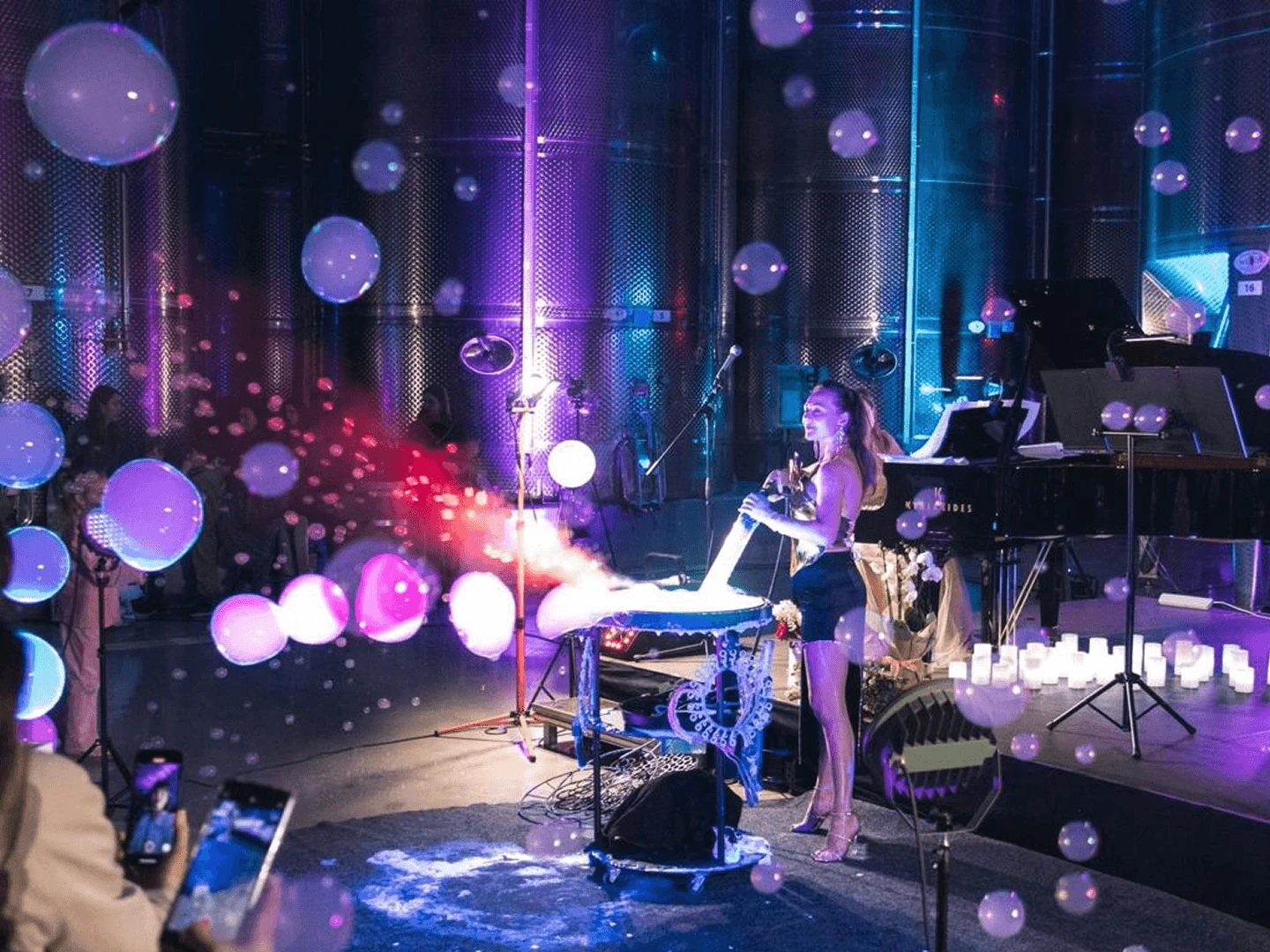
Unusual venues have the shortest booking windows — a winery or gallery may take a single December date

Personalised gifts need lead time for production and delivery — the earliest deadline on the whole list
Early December (2–4 weeks out)
Finalising. Confirm the final headcount — it determines the menu, seating, and the final deposit — approve the menu, agree on performers’ technical riders, and lock the overall timing. Most of the payments are made at this stage.
The week before
The last check. Run through the key moments of the programme, confirm every supplier, and verify the timing and final details. The more thorough this week, the fewer surprises on the night.
Event day
Setup, on-site coordination, and running the evening. By this point, every decision is made — what remains is to execute the plan.
Booking deadlines: what to lock first
Not everything is booked at once — each element has its own deadline. The order of priority looks like this.
| Element | When to lock | Why |
|---|---|---|
| Venue | 3–4 months out | Goes first; sets the date and format |
| Host & key performers | 2–3 months out | The best are taken from autumn |
| Décor & styling | 1–2 months out | Follows the theme and venue |
| Menu & catering | Provisional 1–2 months; final 2–4 weeks | Depends on headcount |
| Transfers & logistics | 3–4 weeks out | Tied to numbers and venue |
| Final headcount | 1–2 weeks out | Drives menu, seating, and deposit |
The planning checklist
A short checklist to work against at each stage:
- 3–4 months out: set the format and budget, choose the date, book the venue, confirm the concept and theme.
- 2–3 months out: book the host and show programme, the décor team, agree a provisional menu, pay deposits.
- 1–2 months out: build the guest list, send invitations, work out the run-of-show, settle transfers and logistics.
- 2–4 weeks out: confirm the final headcount, approve the menu, agree on technical riders and coordination.
- The week before: run through the programme, confirm all suppliers, verify the final timing.
- Event day: setup, on-site coordination, running the evening.
What to do if time is short
Not every party is planned three months ahead — sometimes the decision is made in late November or early December. A short timeline can still produce a strong evening, but the priorities change.
The venue comes first, as it is the most critical dependency: start with what is available on the date you want, and be flexible on the day of the week if needed — a weekday evening is easier to find than a Friday in December. The format then adapts to what is available: a theme that does not need long décor lead times, and a programme drawn from performers who still have openings. Working through a single team or agency that runs all the bookings in parallel rather than in sequence is the main way to win back time on a late start. The one thing not to cut is the host and coordination — they are what hold an evening together when it has come together quickly.
Adjusting for the city
Timelines shift with the venue’s location. In Limassol, demand for corporate New Year events is the highest on the island, so venues and suppliers book out earlier than anywhere else. In Nicosia and Paphos, the pool of venues and performers is smaller, and some hosts and show teams are brought in from Limassol — a normal practice, but one to build into the timing and logistics in advance. For out-of-town venues — villas and resort hotels — early booking matters even more.



Planing your corporate New Year party in Cyprus?
We organise corporate New Year parties across Cyprus end-to-end

Common questions about planning timelines
When should a company start planning its New Year party in Cyprus?
Ideally, three to four months ahead — September or October. At that point, the best venues and suppliers are still free, and rates are below their peak. The minimum workable horizon is around two months, but by December, the choice is already limited, especially for venues and strong bilingual hosts. The venue is booked first, as the least replaceable element.
What is the booking deadline for New Year venues?
The venue is booked first — ideally three to four months out. It is the least replaceable resource: the most sought-after halls, restaurants, and villas on peak December dates go weeks ahead. A booking is held with a deposit, or the date stays open to others. The closer to the holidays, the narrower the choice and the higher the price.
What does a corporate New Year planning checklist include?
It runs by phase: 3–4 months out — format, budget, date, venue, and theme; 2–3 months out — host, programme, décor, and menu with deposits; 1–2 months out — guests, invitations, run-of-show, and logistics; 2–4 weeks out — final headcount, menu approval, and riders; the week before — a run-through and confirmations. On the day, setup and coordination remain.
How far ahead should we book the host and entertainment?
Two to three months ahead. Hosts and the strongest show acts are among the first to be taken for the season, and a bilingual host for an international team is in particular demand. Each is held with a deposit. Leaving entertainment until the last month usually means choosing from whoever is still free rather than who fits the evening.
Can we still plan a good corporate New Year party at short notice?
Yes, with shifted priorities. Lock the venue first and stay flexible on the day of the week, adapt the theme and programme to what is available, and work through one team that runs the bookings in parallel. The host and coordination are the elements not to cut — they keep an evening together when it has been assembled quickly. A late start narrows the choice, but a strong evening is still achievable.
When to Start Planning a Corporate New Year Party in Cyprus
A strong corporate New Year party starts with an early start: the more time the team has, the wider the choice and the calmer the preparation. The best thing you can do for the evening is to begin before the season reaches its peak.
We plan and run corporate New Year parties across Cyprus end-to-end — from venue and concept to programme and on-site coordination. If you are already thinking about the evening, get in touch for an initial consultation. We build a preparation calendar around your date and take on the deadlines, bookings, and suppliers — while the best venues and performers are still free. For the full picture of the season, see our guide to corporate New Year party ideas in Cyprus.